Archive

Warmwater

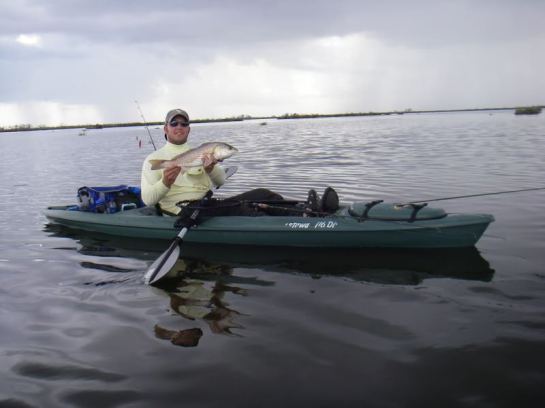
As I mentioned in the last post, I got my start in a Pelican Castaway, which is not a bad boat to start in:
IMGP2141

The most important thing about the Pelican Castaway is it got me on the water, and for cheap.  It had terrible stability and paddled like a wet noodle, but I didn’t know any better and it floated, so I didn’t care. I had it for a little over a year before I found another good deal to pounce on that gave me a chance to upgrade.  A lot of good fish were caught out of the Pelican that year, which really helped indoctrinate me into the kayak fishing lifestyle.  I went from the Pelican Castaway to a Wilderness Systems Tarpon 120.
IMGP4027

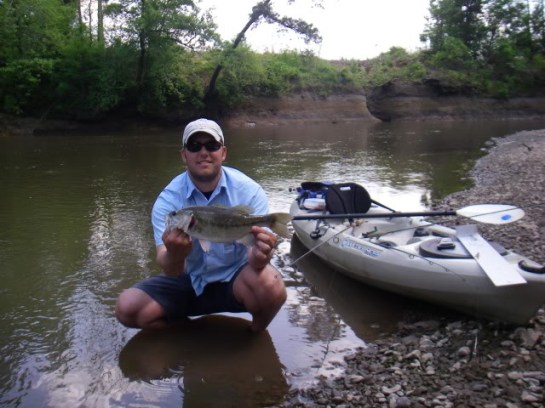
The Tarpon 120 was an excellent upgrade.  You could just look at it and tell it was a better boat than the Pelican.  It was a faster boat, with better tracking.  The quality of the build was so much better than that of the Pelican.  The Tarpon was the quintessential sit-on-top fishing kayak a few years prior to my purchase of the boat.  It was a great boat for me.  It helped that I got a great deal on it too.  Bought it off Craigslist from an old guy with a camp.  The only time he used it was when the camp flooded and he needed a way to get to and from his vehicle.  You can still find essentially the same boat in the Perception Pescador.  The downside to the Tarpon was the stability was not enough that I could stand and fish from it.  It also was not very comfortable to sit in on long trips.  I had the Tarpon for two years and like the Pelican actually made money on it when I sold it.  I got rid of it because I found another great deal on a boat – one that would allow me to stand and sight fish in, but still handle the rivers that we liked to fish.  Capt. Danny Wray put a couple of his Native Ultimate 12’s for sale and the deal was too good to pass up.  I called up my dad to see if he wanted one then made the drive down to Grand Isle and picked up both kayaks from Capt. Danny.

IMGP4398

Owning the Ultimate finally gave me a boat I could stand and fish from.  I had actually gotten pretty good at kneeling and sight fishing from the Tarpon, but that does a number to the knees.  With the Ultimate I also got to experience the comfort of a nice, semi-elevated seat.  Getting my butt off the boat and having my feet lower than my knees while seated helped me to be comfortable longer.  I learned how to stand and sight fish from the Ultimate, it was a great boat for the marsh, and still is.  The Ultimate turned out to be an outstanding boat.  It wasn’t as fast as the Tarpon, but it tracked well.  It was light and easy to transport.  What I didn’t like about the Ultimate was that the standing area was not flat.  With the tunnel hull you had to put your feet in the tunnels and after a while they became cramped.  I also didn’t find it to paddle too well in swift water.  I fell out a few times, which in all likely hood was more my fault than the boat’s.  I actually didn’t own the Ultimate for very long, maybe half a year.  An incredible opportunity came up at that time to join my friend Drew Gregory on the Jackson team and I couldn’t pass it up.  He assured me that the Coosa would be a good fit for me and they wanted to see what it could do in the marsh.  That winter I made a trip up to the Jackson factory, learned about the company and how kayaks are made, met some of the other team guys and of course picked up my new boats.

IMGP5905

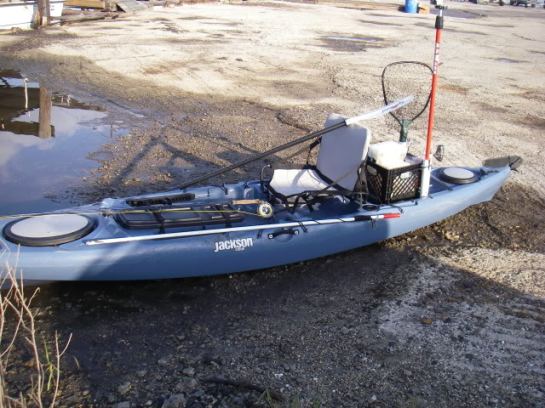
The Coosa was a really fun boat.  Like the Ultimate, it was stable enough to stand and fish from and had the elevated seat that was comfortable to be in from the start of the trip to the finish.  The deck was wide open so standing was comfortable and fly fishing was very easy to do – no snags.  The Coosa is the best handling boat I’ve ever been fished out of, making it  the perfect swift water boat.  It’s home is in rivers and that is where it shines.  It performed well enough in the marsh that I didn’t notice a drop off in performance when coming from the Ultimate.  Where it lacked was it’s open water performance.  With it’s low draft and tall bow, it can catch wind like a sailboat and on open, windy ponds you can expect to be blown to the bank in no time.  The only time this was an issue for me was tournament time because tournament weather is always terrible.  It is a better paddling boat in open water when you weigh down the front of the bow a bit to get it in the water.  I figured that out because as I would catch and keep fish in the front hatch the boat was easier to paddle as the day progressed.  I owned a Coosa up until the Cruise came out from Jackson.  Like I said earlier, it is a fantastic river boat and I owned one just for that purpose.  It wasn’t long after the Coosa came out that the Cuda followed.  The Cuda, in both the 12 and the 14 ft versions has been my go-to boat in the marsh ever since.
IMGP7012

IMG_0534

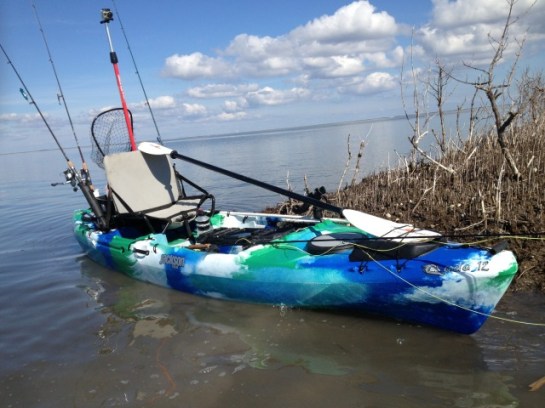
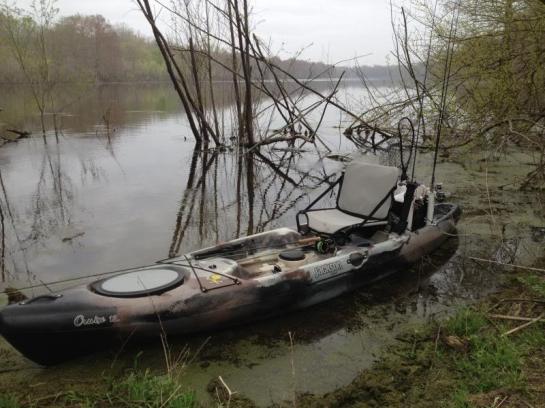
The Cuda has been an incredible boat for me, handling everything pretty well.  The 12 foot version you can take anywhere.  Not as fast as the 14, it is every bit as stable though.  The Cuda is a great platform to stand and fish from.  I have a love/hate relationship with the center hatch.  It catches fly line when fly fishing but that is easily solved by placing something over it, like a towel or a shirt.  I do love the center hatch for storage – whether that be fish or tackle.  No need to turn around and put your center of gravity somewhere other than where it needs to be.  The 14 is a bit faster and provides a bigger front hatch that I find more usable than the small hatch of the 12.  It is heavier though and not as easy to transport as the 12.  The 12 balances really well overhead because the weight is centered on the side carry handles.  You’ve got to compensate for that on the 14 (the Cruise too).  Both the 12 and the 14 have been great boats for the marsh and are better options than the Coosa for inshore fishing.  The Coosa is still the better river boat though.  I owned both until I saw a good compromise between the two was introduced from Jackson – enter the Cruise.
IMG_2513

The Cruise, to me, is a simplified version of the Cuda.  I’ve always been drawn to 12-13 ft boats because they seem to be best size that does river and marsh fishing well.  They are also easier to store when living in a condo, which why I never had a boat over 13 ft until we built our first house and actually had a garage.  Like the Coosa there is no center hatch on the Cruise, which is a good thing for the fly fisher.  It also has the bigger front hatch found on the Cuda 14 – a much better option for dry storage than the small hatch.  The quick day hatch between the legs is convenient and stays dry.  The big plus on the Cruise is the price – right around $900.  In my opinion it is a hell of a boat for $900.

I started carrying two boats once we built our house and I’ve settled in on a Cuda 14 and a Cruise – for now.  The Cruise is great for the river and those small freshwater ponds I like to fish where the Cuda 14 is at home on inshore bays and in the marsh.  As a second boat the Cruise is a good boat in the marsh if I have someone that wants to tag along or if I’m looking to solely fly fish – that’s what I’ll take.  I’m sure another one day soon enough another boat will come along that catches my eye, but for the fishing that I like to do I can’t think of two better options than the Cruise and the Cuda 14.
IMG_2863IMG_2864 IMG_2869 IMG_2867 IMG_2866

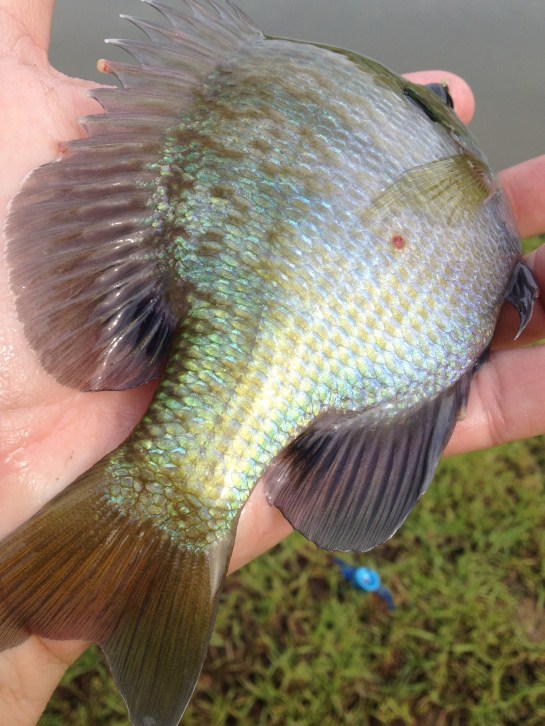
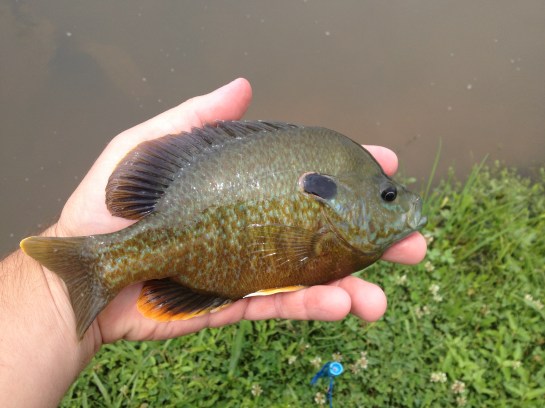
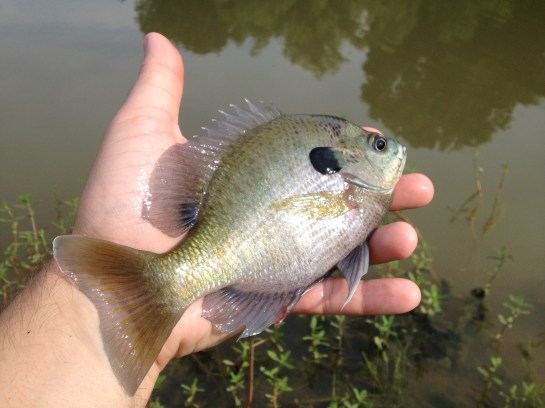
Found the bream honey hole the other day in one of our ponds in the neighborhood.  It was palm sized panfish on every cast.  The bass fishing was slow so hitting this bream spot saved the day.  Seems like this kind of action normally occurs earlier in the year.  All fish came on the dropper, but they wouldn’t have been able to fit their mouths around the popper anyway.

Hard to believe it has been almost five years since Blake caught his state record spotted bass.  It’s also hard to believe that back then redfish weren’t our primary focus, it was spotted bass.  We were intent on breaking a record we thought was very attainable – the state record spotted bass on the fly.  Don’t call us record hunters though as it took 2.5 years for one of us to finally land one over 2 lbs, Blake came through and landed two in one day.  I’ve still yet to catch one over 2 lbs on the fly rod.  Shoot, it’s a good day when you catch one over 1 lb!  Thinking about his record and after a short conversation I had with Mike Tringali about the Choctaw bass earlier this week, my interest in our local spotted bass has been restored.  I had to go back to the old Riverbassin’ forum where we relayed our trip reports to each other and read about Blake’s day again.  I think it is worth a share here(I updated links and edited for spelling and grammar from the original):

08-18-2009

Well, August 14th was a good day that was about two casts from being one of the most frustrating days that I have ever had fishing. I had put in a few extra hours at work during the week and decided to take off to the stream, arriving around 2:30 in the afternoon. I started fishing and was doing pretty well on a crease fly catching above average fish in both size and number. I waded all the way to where I normally turn around and decided that I would just go one more bend in the stream just to check out what things looked like. Well, when I got around the bend I saw a deep pool that I figured would hold some nice fish. I was pretty surprised at what was about to happen. First, a little background about the stream, the average fish that we normally catch on the stream is around 9 – 10 oz and maybe 8 – 9 inches (maybe a little smaller). This day, I was getting bites from (not always catching) spotted bass that were ranging anywhere from 3/4 to 1 1/4 pounds on a consistent basis.

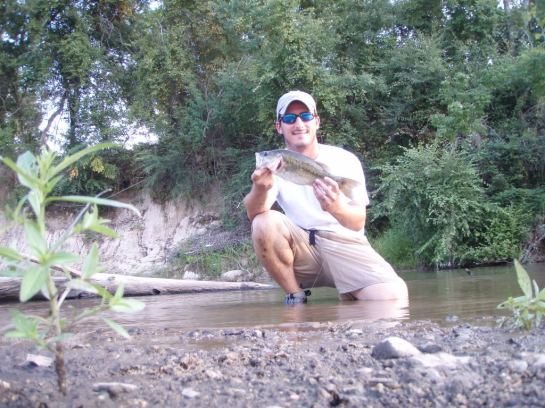
Anyway, I started casting in the last deep pool that I was going to fish and caught a pretty nice fish on my first cast.

OLYMPUS DIGITAL CAMERA

On the next cast, I caught a fish that I believe would have surpassed the Louisiana state record spotted bass on a fly rod. So now I have a decision to make. I didn’t have my scale or a stringer and I was 1.75 miles away from my truck and would have to carry the fish all the way back. I decided to just bite the bullet and let the fish go, hoping that I catch it again in the future. This fish far surpassed any fish that I have caught in this stream in the past 2.5 years. Below is the picture that I snapped using the timer feature on my camera before I let it swim…

OLYMPUS DIGITAL CAMERA

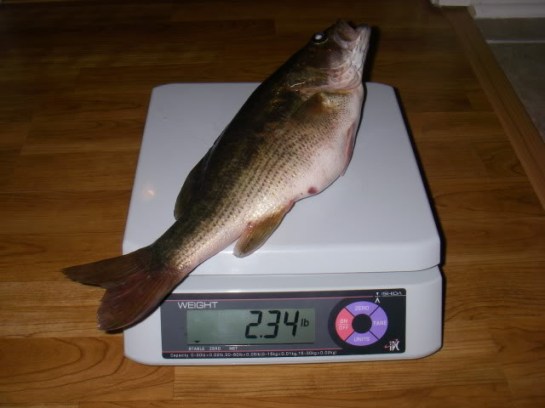
After this, I was pretty p.o.’d about not being prepared to catch a fish like this, this far away from the truck. So to pass some of the time on the walk back, I called Ben and told him that I thought I had just released the state record (he and I have been saying that we were gonna break the record and I even said that I would when I introduced myself on a thread on this site). Well, I get pretty close to my truck and it’s still daylight, so I figured I would fish a stretch that I didn’t have much luck at earlier in the day but Ben had caught a good one at on a previous trip. On my second cast I had a huge bite and set the hook. I thought I was caught on a log. Then the fish ran and I realized that I had a fish that was fighting harder than the one that I had released. I ended up landing the fish and in the end, It weighed 2.34 lbs and should be the state record. I’m still getting all the needed info together to send it in. Thought it was a cool story and figured I would share.

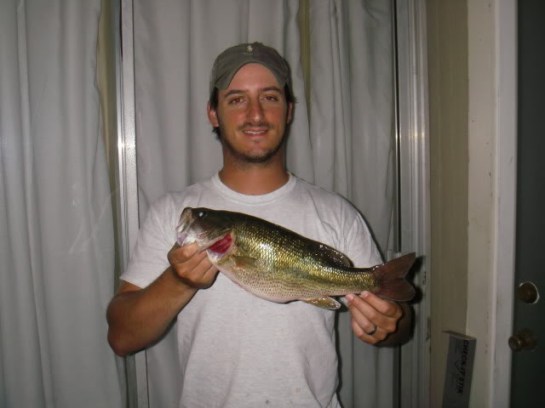
IMGP3113IMGP3114IMGP3119

08-19-2009

I had the fish weighed on a certified scale witnessed by two others (my wife and Ben), identified by a biologist other than myself, and signed off on by myself. The only thing that I have left to do is print out the pictures and send in the paper work with a 25 dollar check. I also have to send in the fly and leader that I caught the fish with.

I had the fish analyzed at work. Turns out that it was between 5 and 6 yrs old. The upper limit for spotted bass in the area is 7 years old. The fish had a 5 inch longear in it’s gut that helped push it over the edge on the scales.

I got to talking with some of the biologists that are doing spotted bass profiles in the watershed and have been included in the “collection” of fish from the streams that I fish. Looking forward to the next sampling day for sure

10-12-2009

http://laoutdoorwriters.com/louisiana-fish-and-big-game-records/louisiana-fish-records/

Congratulations to Blake on officially making the record books. Scroll down to page 33 – Fly Fishing division, spotted bass.

10-20-2009

Here it is:

OLYMPUS DIGITAL CAMERA

But I’m sure that it will be broken soon with Ben, Barret and I all really getting into the river fly fishing and spotted bass thing. Especially with the kayaks, it opens up a lot more and bigger water to fish. If it wasn’t $25 and I didn’t have to give up my fly and leader, I would fill up that list just to see my name on it nine times.

Blake had an incredible day that day and we followed it up a few days later with another great day.  No 2 lb bass were brought to hand then, but several 1+ lb bass were.  Most were caught on his crease fly which I’m going to go ahead and post that below as it is still an awesome fly to use for spotted bass.  He has also done an articulated version that you can find in the Fly archive, but this is the original, and Blake’s first SBS(Again, I took the liberty of editing the original for spelling and grammar).

Chartreuse baby bass crease fly SBS

Well here goes, my first step by step:

Materials

  • Hook – Size 2 Orvis Bass Bug, Item No. 8810.
  • Tail – Chartreuse and Olive marabou, crystal flash
  • Thread – Danvilles 3/0 waxed monocord
  • Body – 2mm closed cell craft foam
  • Coloring – black and red permanent markers, Roseart metallic marker
  • Googly eyes
  • 5 minute epoxy
  • Superglue
IMG_1242
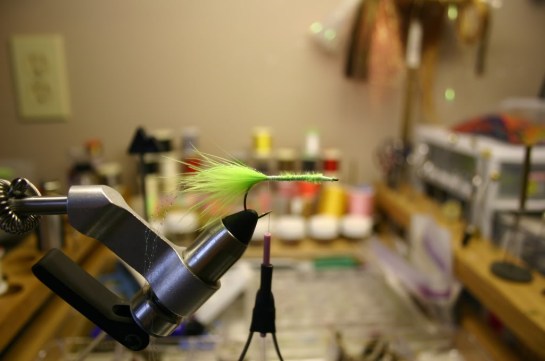
The first step is to tie in the chartreuse marabou tail and the crystal flash on top of that.
IMG_1247
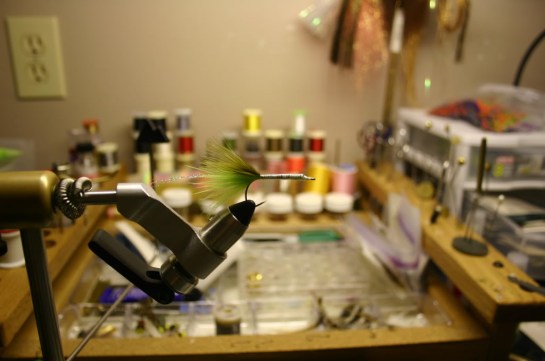
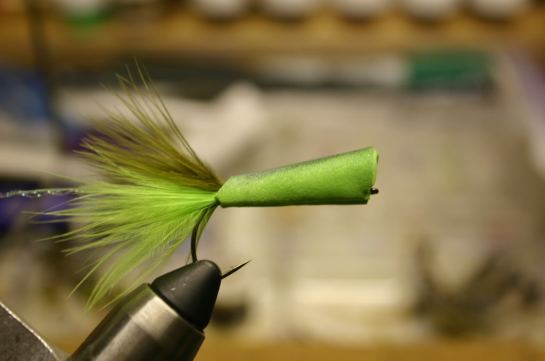
Next, tie in the olive marabou. I try to wrap the marabou all the way down the shank with thread so that I have something with a little bulk to glue the foam to. Cut the flash to about an inch behind the marabou tips. I leave it a little long as it can always be cut down later on.
IMG_1248
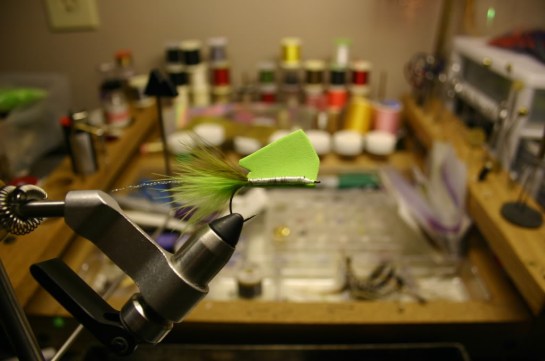
Next would be to cut out the piece of foam using a template. I messed around with different shapes until I found a shape that suited most of my crease flies and then made the template out of card stock.
IMG_1246
Color the foam. The metallic markers don’t dry right away, so I make a pretty heavy line and smear it with my finger to get the faded look from top to bottom. I find it easier to draw the lateral line and add eyes after the fly is glued, but it doesn’t really matter if you do it now or wait until after.
IMG_1254
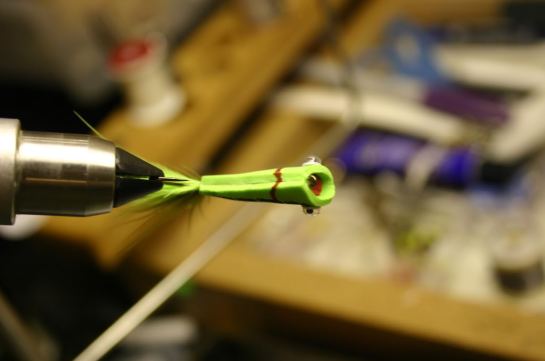
I glue one side of the foam to the shank leaving enough under the shank so that when I glue the other side of the foam, the ends of the foam are glued together so that the shank doesn’t show through the crack.
IMG_1255
Then glue the other side.
IMG_1258
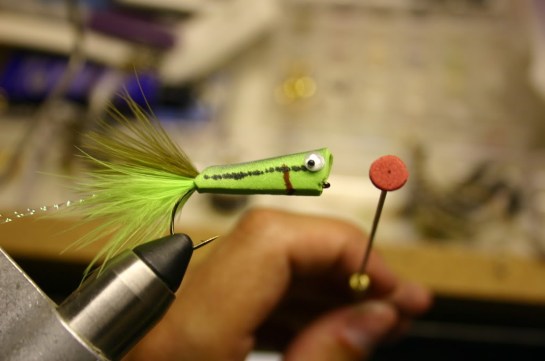
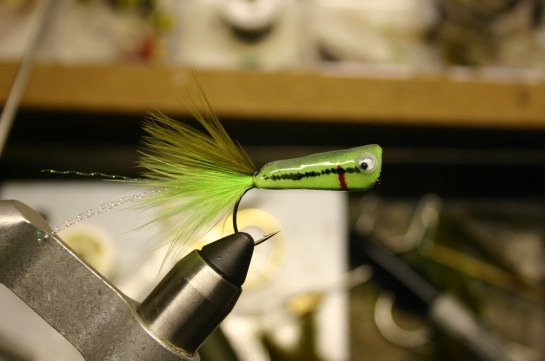
I then draw the lateral line and add the eyes and the gills(I use both googly eyes and stick-on eyes).
IMG_1259
I cut a hole(using a hole punch) from some red foam and insert it in the end of the fly using my bodkin. I use super glue to secure it in place. The second picture shows the closed ends of the foam on the bottom of the shank and also the red plug in the mouth of the popper.
IMG_1260
IMG_1261
The white baby bass is another good pattern. For it, I would substitute white marabou for the chartreuse marabou. I also colored the mouth part red on this fly. No reason why, just thought it looked good.
IMG_1264
I then add a light coat of 5 minute epoxy for durability – finished fly.
IMG_1262
IMG_1266
Proof of concept…
OLYMPUS DIGITAL CAMERA
IMGP3116