Archive

Fly Tying

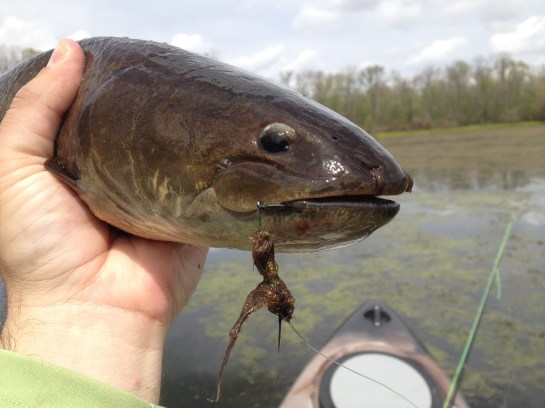
Y’all remember that choupique I caught on the fly back in April? It was actually taken on one of Blake’s flies that we have featured here, the redfish intruder.  This one:
IMG_2553

IMG_2555

IMGP8624

I just got word on May 25th that it is officially the new state record bowfin taken with a fly rod.  Weighing in at a whopping 4.07 lbs, how could that little guy be first place?  Turns out there was no fly rod bowfin category prior to my submission.  I knew that so I figured it was worth a shot to submit it and at least get the category started.  Louisiana’s state records are not run by the Department of Wildlife and Fisheries but rather the Louisiana Outdoor Writer’s Association.

Instead of having open categories for every fish found in the state, I guess they prefer that you go through the process of asking for consideration of a category prior to putting it into place.  Then you can submit your fish, which requires it to be weighed on a certified scale, identified by a state biologist, and multiple hard copy pictures sent in via snail mail.  If you see where I’m going with this you’ll understand that the process is a PITA.  It is no wonder that more people don’t submit their fish for state record consideration in Louisiana.  Oh, and it cost me $25 to make the submission.  All this leaves me wondering why it has to be so hard?

At any rate you’re looking at the state record holder for choupique on the fly, for whatever that’s worth($25). Follow this link to take a look at Louisiana’s state records.


The fly of the month for April is the spawn of a beadheaded woolly bugger and the pickle. Each of these flies has been extremely effective on trout at the cabin, the hope here is that this fly is doubly effective. Okay, so I don’t think it works like that, but this fly should work pretty well too. We’ll put it to the test Memorial Day weekend. Thanks to Blake for another great pattern.

Materials:

  • Streamer hook of your liking
  • Bead to fit hook
  • Lead wire for the shank
  • Marabou
  • Rubber legs
  • Hackle
  • Dubbing
  1. Put your bead on your hook and wrap the shank with as much lead as is desired. Getting this fly down in the water column will be important, so I put a good bit of .020 lead on. The heavier the fly, the less shot that I will have to put on. Slide the lead up the shank so that it butts up against the bead. This helps keep the bead in position.

IMG_2094

2. Lay down a layer of thread to lock everything in place.

IMG_2095

3. Tie in your marabou at the bend, a little shorter than as if you were tying a normal woolly bugger.

IMG_2096

4. Tie in a leg on either side of the tail.

IMG_2097

5. Bring your thread to the midpoint of the shank and tie in another leg using figure 8 wraps. Repeat for the other two legs.

IMG_2098

6. Tie in the hackle with the curved side facing out. We want the barbs to point towards the tail rather than forward when we palmer it back.

IMG_2100

7. Dub the body of the fly starting at the head and finishing at the bend. Leave the thread here to use to catch the hackle for the ribbing.

IMG_2101

8. Palmer the hackle to the bend. When you get to the bend, grab the thread and make a wrap catching the end of the hackle. Then spiral wrap the thread as a rib to the bead.

IMG_2102

9. Clip the hackle tip and whip finish behind the bead. Finished fly.

IMG_2104

IMG_2107