New Zealand 2013: A Dry Fly Short
1 Comment

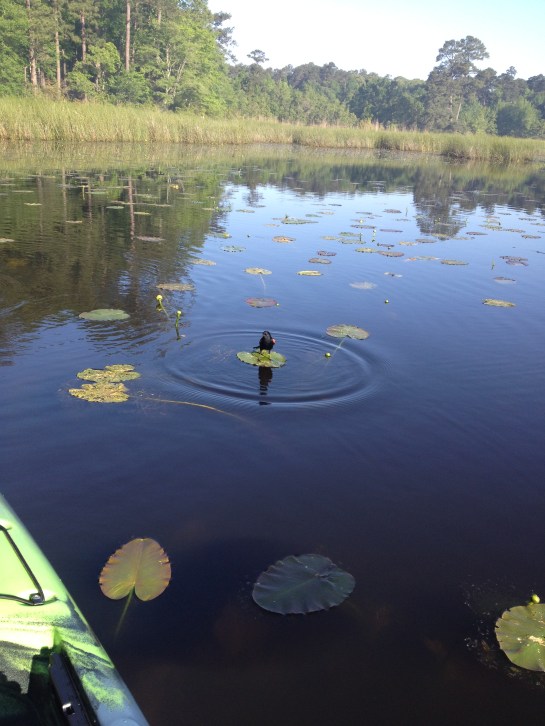
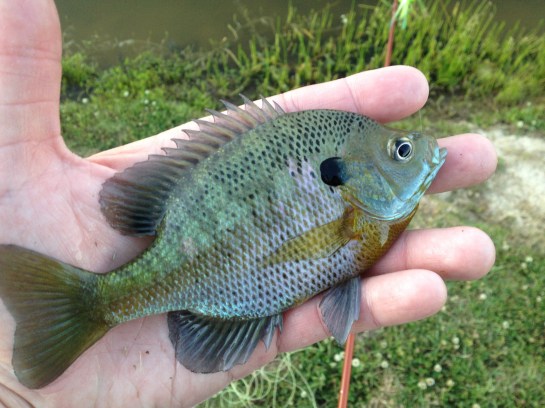
Took the family up to Alexandria this past weekend to visit my sister and her husband. Kurt and I spent a few hours Saturday morning on a local lake. It was a beautiful morning, conditions seemed perfect, but the bass were uncooperative. Kurt caught a small one and I blanked. After that all we could catch were tiny bream. Although I caught fish it still felt like a skunking. It was a nice paddle on the lake, I just wish the fishing was better. This red-winged blackbird kept me entertained for a little while, hopping from one lily pad to another eating bugs along the way.
Fast forward a couple days and at my door when I got home from work yesterday was a new fiberglass rod I purchased. I’ve been wanting to see what all the fuss with glass rods was about and with Cabela’s putting the CGt series on sale and myself having a gift card to spend, now seemed like the perfect time. I got a 7′ 3wt, which should be perfect for those small streams in Georgia and the neighborhood pond – which I had time to hit that evening.

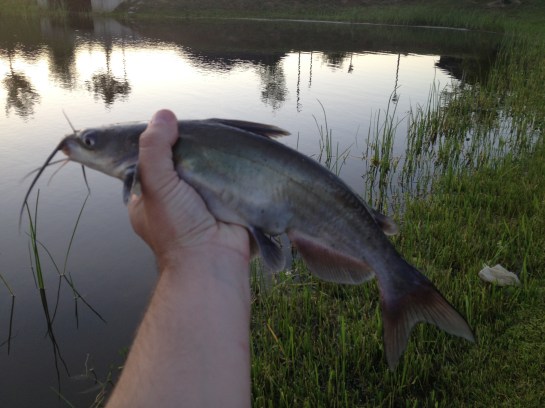
I strung the rod up with 3wt line, grabbed a beer, and walked down to the pond for some non-stop bluegill action. I had a stealth bomber tied on and hung a zug bug underneath. The zug bug saw 90% of the action and caught mostly small fish while the bomber caught a few palm sized gills. I ended the evening fish with a solid bend in the glass rod courtesy of a healthy channel cat, who somewhat surprisingly ate the little zug bug.
I was impressed with the CGt, when you pick it up and give it the wiggle test(that most fly fishermen do, but have no idea why they do it) it feels good and flexes throughout like I imagine a glass rod would. After the wiggle test I was kind of expecting it not have a backbone, but it did and you could feel it when you shot a good bit of line out. I saw it during the fight with the catfish as well, it handled it like a champ. The cork on the rod seemed to be of a pretty good quality, very smooth to the touch. My wife liked the color of the rod blank and I do too, it’s not an ugly rod. I could do without the slip ring reel seat, which is not my favorite way to secure a reel, but that is what was offered on the 7′ 3wt version. So far I like it, I will continue putting it to the test in the neighborhood on the bass, bream and catfish and later this month in Georgia on some small stream trout.

The fly of the month for April is the spawn of a beadheaded woolly bugger and the pickle. Each of these flies has been extremely effective on trout at the cabin, the hope here is that this fly is doubly effective. Okay, so I don’t think it works like that, but this fly should work pretty well too. We’ll put it to the test Memorial Day weekend. Thanks to Blake for another great pattern.
Materials:

2. Lay down a layer of thread to lock everything in place.

3. Tie in your marabou at the bend, a little shorter than as if you were tying a normal woolly bugger.

4. Tie in a leg on either side of the tail.

5. Bring your thread to the midpoint of the shank and tie in another leg using figure 8 wraps. Repeat for the other two legs.

6. Tie in the hackle with the curved side facing out. We want the barbs to point towards the tail rather than forward when we palmer it back.

7. Dub the body of the fly starting at the head and finishing at the bend. Leave the thread here to use to catch the hackle for the ribbing.

8. Palmer the hackle to the bend. When you get to the bend, grab the thread and make a wrap catching the end of the hackle. Then spiral wrap the thread as a rib to the bead.

9. Clip the hackle tip and whip finish behind the bead. Finished fly.


 Mountains to Marsh