Archive

Fish

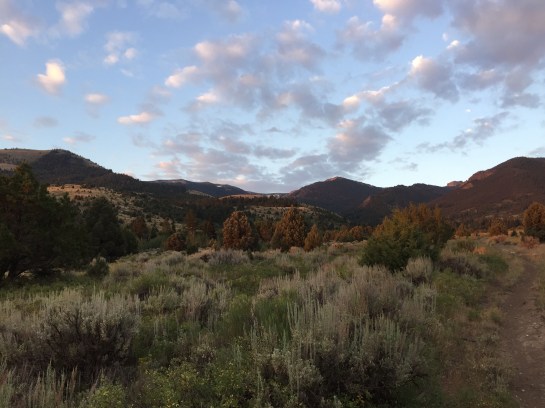
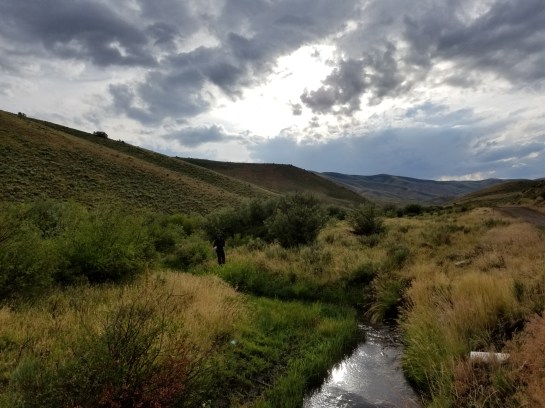
The first night of hammock sleeping on a week long camping trip is always tough so as soon as I saw twilight the next morning I was up and at ’em.  A short, chilly walk to the bathroom began to reveal the beauty of the Raft River Mountains and the valley we were in.  We had arrived in the dark so I didn’t know what to expect, but this campground had some of the best views out of any that we stayed in.  The remoteness of it was pretty awesome.  If you’re interested in heading to NW Utah to camp, Clear Creek Campground is the only campground option in the Raft River Mountains and it is free to stay there.

IMG_2675

IMG_2681

IMG_2687

IMG_2692

Shortly after my walk we packed up and hit the road.  After a brief drive through Idaho the next stop was the Logan Canyon where we would be targeting Bear River cutthroat.

20170727_073909

The Bear River cutthroat is not actually a formally described species.  Federally the cutthroat in the Bear River system (including Bear Lake and the Logan River) are considered Bonneville cutthroat trout.  Obviously the state of Utah thinks otherwise so I had to do some reading to learn what makes these cutthroat unique.  It has been pointed out by scholars, most notably Dr. Robert Behnke, that the cutthroat in the Bear River system actually are more closely related to Yellowstone cutthroat trout due to a Bonneville Basin high water diversion between the Bear and Snake River drainages some 34,000 years ago.  If you want to learn more about native trout and native cutthroat I can suggest two books for you.  Trout and Salmon of North America by Dr. Robert Behnke and Cutthroat: Native Trout of the West by Patrick Trotter are absolute must-owns for any fish nerd.  They make great coffee table books as well.

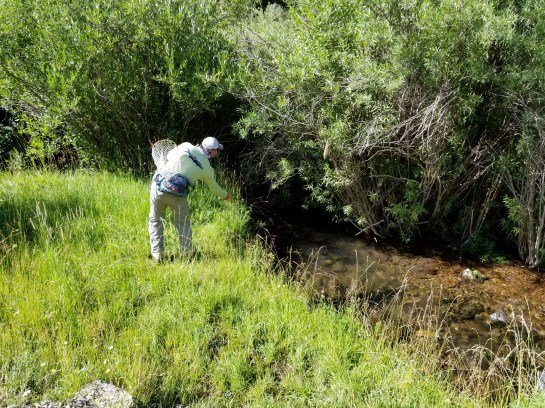
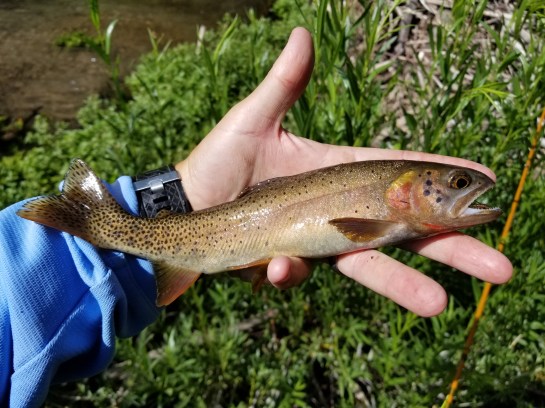
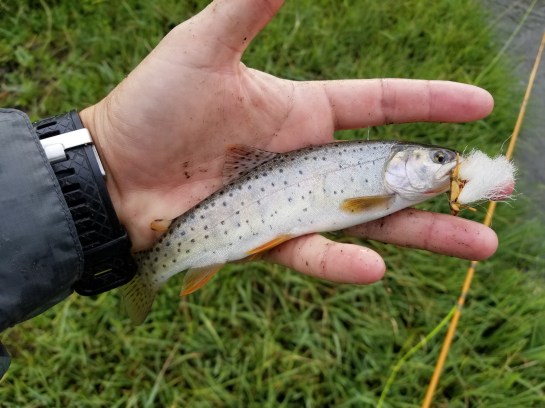
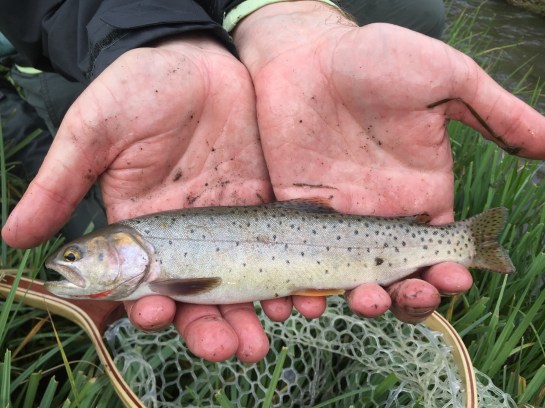
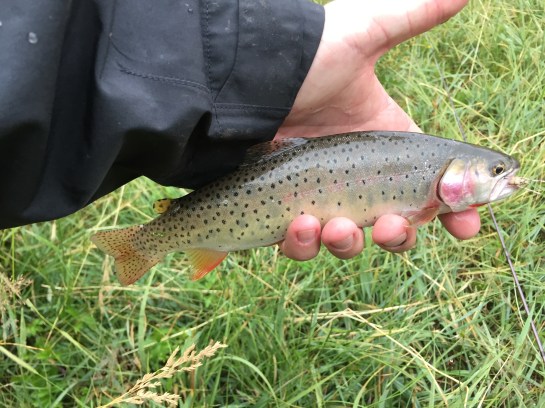
We started our fishing on a Logan River tributary where we parked at a trailhead and planned on fishing up from there.  I got ready a little quicker than Blake so I made my way over to the creek to check it out and as soon as I did I saw a cutthroat holding next to the bank.  One float of a dry fly in front of him and my second cutthroat species of the slam was checked off the list.

IMG_2700

Then I caught another one.

20170727_101543

IMG_2703

IMG_2707

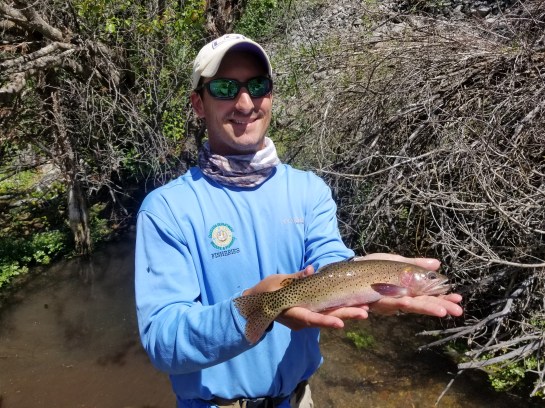
And Blake caught one of his own.

20170727_100143

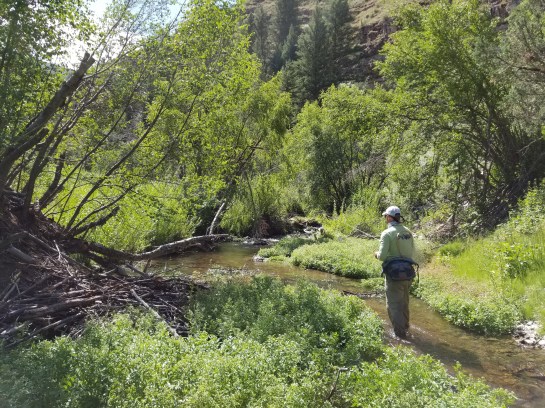
Now that the pressure was off we were ready to spend the rest of the day looking for bigger ones.  The stream was pretty tight in some places and had lots of overhanging vegetation – great fish habitat, but kind of tough to fish.  In other places it was more open and easier on the fly rods, especially where there were beaver ponds and slower water.  There was lots of variation throughout which made for a pretty interesting little creek.  I feel like the size of the cutthroat we caught was pretty good for the size of the water, it was a great stream for our 3 and 4 weight glass rods.

IMG_2719

20170727_112038

IMG_2717

20170727_112405

IMG_2727

20170727_114406

20170727_114750

20170727_120358

We had covered maybe 3/4 mile of stream and caught several nice fish before another group of three anglers passed by on the trail and dropped in at a trail intersection just upstream of us.  We had one more fish in us on this stream before we broke for lunch and Blake made his fish count.  It was the biggest on the day so far and a great way to end that session.

20170727_121758

20170727_121818

20170727_121836

We hiked out and set out to find a suitable campsite for the night.  Sleeping in hammocks requires sturdy trees to hold us so sometimes finding a good campsite can take a little extra time than with a tent.  There are numerous campgrounds in Logan Canyon though and despite them starting to fill up for the weekend we found one without too much hassle at Wood Camp.  We set up camp, had lunch and then hit the water again.

IMG_2746

IMG_2747

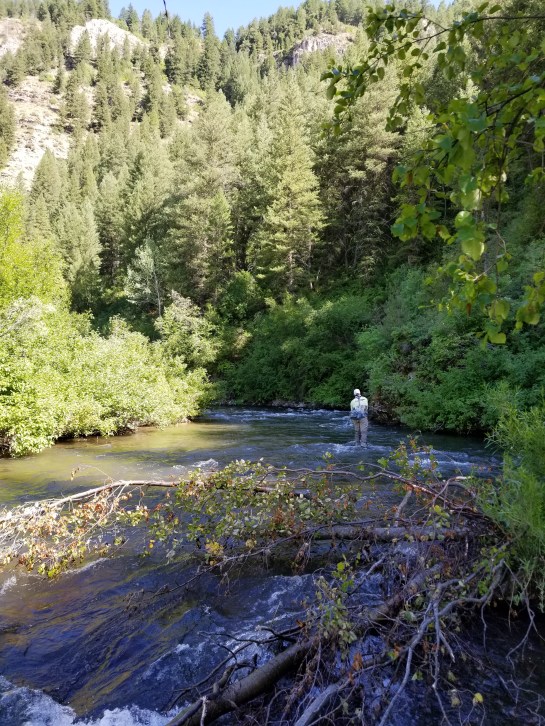
We fished a section of the Logan that ran away from the road a bit just upstream from the campsite.  It was big water compared to what we were used to and the wading was pretty difficult mainly due to the depth and volume of water moving through.  We weren’t getting many strikes and then finally I get a good take on my dry.  I can feel the weight of a solid fish, I know it’s a good fish because I can feel each deliberate head shake.  Then just as quickly as I was hooked up here comes the fly back at me.  I pulled it from his mouth.  I’m guessing it was a big brown since the Logan is known for them, but I don’t really know.  I do know that it would have been a good fish, best of the trip for me.  After that we decided to move a bit further upstream, hopefully find some safer wading.

20170727_163730

IMG_2753

I’ve heard the legendary Madison River in Montana is called the 50 mile riffle and I had read that the Logan was like a mini-Madison, from what I was seeing this was holding true.  The river was dominated by riffles and runs.

IMG_2758

I was throwing a dry-dropper with a stimulator up top and a green caddis pupa style nymph below and at some point I began holding my mouth right and hit a fish-catching rhythm.  I had 6-7 cutthroat in a row fishing the different seams and holding water.

IMG_2754

IMG_2755

IMG_2772

I caught my biggest cutthroat on the day in that stretch.

IMG_2761

IMG_2765

I even had a few browns come up and slam the dry.

IMG_2769

20170727_191257

20170727_191242

Blake didn’t fare as well, it was one of those rare times when I out-fished him, but he did come away with a solid cutty from the Logan.

20170727_183442

Things slowed down for me after that productive stretch of water, more of a return to normal really.  It was starting to get dark out and we were starting to get hungry so we hit the road back to the campsite.  It was nice already having the hammocks set up, so all we had to was make a fire and cook dinner.

IMG_2773

IMG_2775

We generally eat pretty cheap on these trips, just boiling water and eating dehydrated meals, but tonight was different.  We actually bought a couple of ribeyes and some potato salad and ate pretty good that night.

20170727_211612

20170727_212853

For Day 3 we’d fish another Logan trib and then hit the road to hit the North Slope of the Uintas.  The next cutthroat on our list was the Colorado River cutthroat.

Blake and I just recently got back from a week in Utah, chasing the four native cutthroat of that state.  Flights for the trip were booked seven months ago so it’s safe to say that the trip has been on my mind in some capacity throughout all of 2017.  Admittedly though, having an infant certainly cut down on the amount of space that the trip, or any fishing trip for that matter, has occupied in my brain.  Want to think about fishing less – keep having kids – it totally works!

Fishing in Colorado in 2012 was enough to convince me that I needed to take more trout trips out west.  Having an interest in native fish and more specifically native trout meant that the Wyoming cutt slam was on a very short bucket list after Colorado.  After the success we had fishing in Wyoming in 2015 I knew I wanted to do something similar for the next trip.  I’m always thinking about the next trip, logging things I read in books or on the web for future use.  I gravitate toward the slam style programs.  They provide great outlines for planning a western trout trip.  If you want to catch four different species in their native ranges you typically have to travel to four different watersheds.  It’s a great way to fish a lot of different water and see a lot of sights that you can’t see back home.  Driving to the destinations at times is as much fun as fishing.

I looked at California’s Heritage Trout Challenge, but that seemed impossible to achieve in a week and I wasn’t looking for a two or even three part trip just yet.  Nevada has a Native Fish Slam that seemed a little more plausible, but I was a little hesitant about some of the remoteness of the destinations we would need to go to find those native fish.  At some point I want to make it to New Mexico to chase Rio Grande cutthroat and Gila trout and Arizona for Apache trout, but those are likely separate trips, otherwise that would be a lot of driving for one week.  Then in April of last year, my planning suddenly shifted to Utah as they debuted their own cutt slam program with a really fantastic website – www.utahcutthroatslam.org.  After looking into it further it just made sense for the Utah cutt slam to be our next trip.  Salt Lake City is an easy destination to fly to with relatively inexpensive flights and as a bonus you can catch all four cutthroat species within a three hour drive from the city.

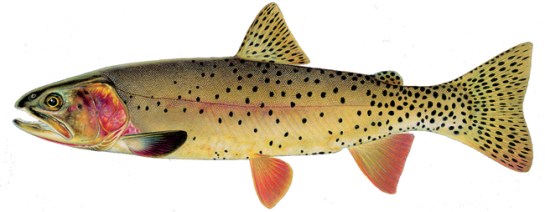
To achieve the Utah cutt slam you’ll need to catch the four native cutthroat trout of the state – the Bonneville, the Bear River, the Colorado River, and the Yellowstone.  Here’s where they live:

Since the Yellowstone cutthroat required the longest drive, was in the most out-of-the-way destination, and lived in some of the least impressive looking water I decided we should try and knock that one out first.

OncorhynchusClarkiiYellowstoneH650

Joseph R. Tomelleri

We got the earliest flight we could into Salt Lake City from New Orleans and after a few stops for supplies we set off for the Raft River Mountains, in the NW part of the state.

20170726_173148

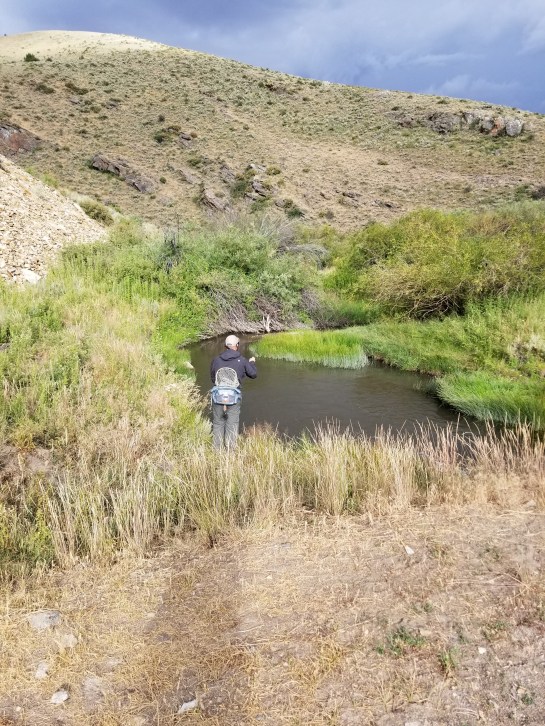
Miles of interstate were followed by miles of dirt roads, but we finally arrived that evening at our first creek.  It was a small one and it was heavily used by cattle.  The cattle and the creek shared the same narrow valley and there was only so much space for the both of them.  The Yellowstone cutthroat were supposed to be there too, but it was obvious there wasn’t a very large population in the creek, so we went to work and started covering ground.

20170726_184600

20170726_190508

Thankfully the cattle weren’t around at the time, but the cow shit was still there and avoiding it was impossible.  I noticed how covered my boots were when walking back to the car.  After fishing a few prime runs with nary a bite I was a little nervous.  It didn’t make me feel any better when the skies opened up, so I took off my dry and started fishing a nymph.  All we had to do was catch one right?

The heavy rain didn’t last long and as we moved up the stream things started to look better.  Blake caught a trout to get things rolling.

20170726_192220

IMG_2633

I followed up with one of my own and all was right in the world again.

IMG_2631

More fish were caught and once you got past all the cow shit the stream wasn’t really that bad of a place to fish.  The treeless mountains at the head of the valley made for a pretty cool backdrop too.

IMG_2635

IMG_2640

IMG_2639

IMG_2651

20170726_194108

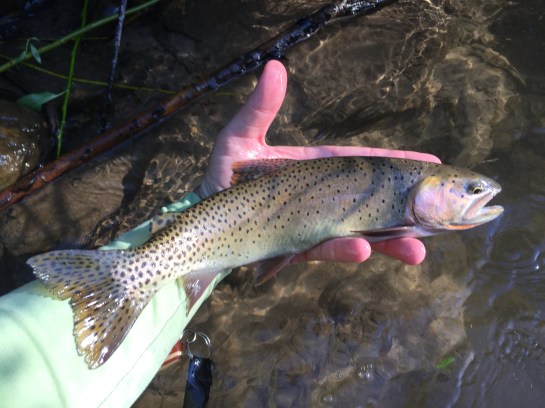
The size of the fish picked up as we went upstream, we never found any studs, but we found our target species and to catch the first of the four cutthroat species we needed on our first day in Utah was a pretty good feeling.

IMG_2650

IMG_2654

IMG_2661

We only spent a couple hours on that stream before we figured it was late enough and we still needed to find a place to sleep and set up camp.

IMG_2665

Much like Wyoming we’d be hammock camping each night in National Forest campgrounds (I like a real toilet).  Unfortunately the nearest campground was still over an hour away, so we’d be navigating to and setting up camp in the dark.  Thankfully I had printed out directions to get from place to place because there is not much cell coverage in rural Utah.  We did well finding the roads we needed to turn on and dodging jackrabbits in the dark, but we were pretty confused when we pulled into someone’s driveway at 10:00 at night and three dogs surrounded the car barking up a storm, then we realized we made a wrong turn somewhere.  We backtracked to the main road and righted the ship pretty quick, but that could have made for an interesting conversation should anyone have stepped out from that trailer.

The next day we’d wake up and head east, over to the Logan Canyon where we hoped to catch our second cutthroat species, the Bear River.

After the success of their last Louisiana trip Jameson and Brooks with JK Media House made a return trip to Louisiana this past weekend for another round of fishing and filming.  This time they brought with them the all new Coosa FD, Jackson Kayak’s first pedal drive boat, for some pre-production testing in our Louisiana marsh.  I couldn’t pass up the opportunity to try out the new flex drive system and of course hang out with my good friends so I joined them for a day and a half worth of fishing down in Pointe-aux-Chenes.

I haven’t talked much about the FD here as I wanted to wait until this boat was actually in production before I got all excited about it, but after about a year’s worth of speculation the time has finally come.

Coosa-FD-1-2

It’s no secret that the more time your bait spends in the water the better your chances are at catching fish and having a pedal drive system is a great way to keep that line in the water.  What sets the flex drive apart from other pedal drive systems is it’s flexibility – it’s right there in the name.  The flex drive moves up and over underwater obstructions, protecting the prop and other moving parts from damage.  I got to experience this firsthand the last couple of days and it works as advertised – oyster beds are no problem for the FD.

I met up with the guys at PAC Kayak Rental where Eddie and Lisa Mullen operate the finest kayak launch around.  They were incredibly gracious hosts to the Jackson team back in December and were a big reason that they decided to head back down to Louisiana again here in June.  The excellent fishing has a little something to do with it too, but excellent customer service goes a very long way – something the folks across the canal from Eddie and Lisa never learned.

We got on the water in the hottest part of the afternoon and I got my first taste of pedaling, rather than paddling, a kayak.
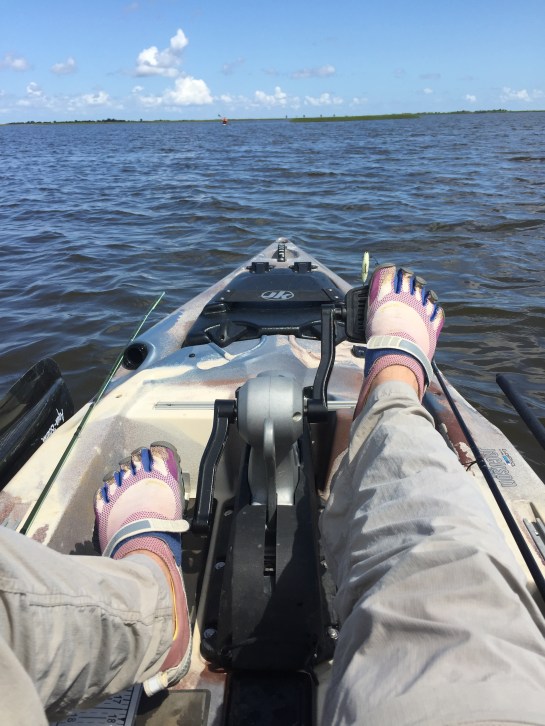
IMG_2231

Jameson was very quick to point out that the boat I was in was still a pre-production model, meaning we were essentially beta testing the new boat and providing feedback before a production model is actually produced.  More specifically the flex drive system was still in pre-production and could still be tweaked before production models actually went out – I’m pretty sure the hull was already in production as change to that are a lot harder to make.

Regardless I was excited to be on the water in Jackson’s new pedal drive boat.  I’ve got to admit, my whole kayak fishing experience has been from a boat you paddle, the pedaling thing was very awkward at first for me.  It took me a little while to find the right distance to sit away from the pedals and comfortably pedal – luckily on the FD the seat trims fore and aft on a track system and it was very easy do while on the water.

Rudder controls are found on either side of you on the FD and these control how well you track in the boat.  While at speed it didn’t take much of an adjustment on the rudder control to steer the boat left or right.  It took me a while to get use to that as well.  I kept wanting to make big adjustments of the rudder and in doing so my track looked more S-shaped than it really should have been.  I’m chalking that up to user error since by the end of the trip I was pedaling straight and true.  Being in a new boat for the first time there is always an adjustment period and for me being in a pedal boat for the first time that adjustment period took a little longer.

The fishing was not on fire that afternoon for me, but eventually I found some redfish right as the weather was beginning to look scary.  I got into a natural bayou that connected the canal with a pond and began to hear redfish attacking fiddler crabs on the bank – one of my favorite sounds.  That’s why sight fishing is not just about seeing fish, but it’s also about hearing them and when that happens you’ve got to locate those fish as best you can based on where you hear them and then patiently wait until they surface again or you see them cruising.  Shrimp popping out of the water along the grass line are a dead giveaway and that’s how I caught my first red.  I pitched a Matrix Shad in front of the popping shrimp and it got hammered by a nice mid slot red.

I was able to catch that one and another before the thunderhead released it’s down draft and made us evacuate the area.  Jameson and I took shelter in “tetanus city” under an old dilapidated camp that may have had more metal on the ground than in the air.  We never actually got rained on, but the wind was enough to move us off the water, after it was all over we headed back to the launch – hunger overtaking the desire to catch fish.

On that pedal back I actually paddled, which gave me a chance to see how much of a bear the boat was to paddle.  Surprisingly it actually paddled pretty well.  With the drive system up it tracked well and paddled at a decent speed compared to Jameson’s pedaling.  Now I wouldn’t want to paddle it all day, but if I had to I could and that’s all that matters in an emergency situation.

The next morning we got to do a mothership trip which is offered by Eddie at PAC Kayak Rental.  He ferried our kayaks 8 miles south into pristine marsh that rarely sees a kayak or even a boat.

IMG_2236

IMG_2237

It was a very pleasant boat ride in protected water the whole way.  When we arrived at our destination we still had cell phone coverage so should we have needed anything from Eddie he was just a phone call away.  The marsh was beautiful in what Eddie called the “Promised Land”.

IMG_2241

After spending a half day on the FD yesterday I was far more comfortable in the boat today.  One of the really nice things about the boat is it’s incredible stability.  Standing up and sightfishing from this boat is no problem – there is amazingly little rock from side to side.  It’s like fishing from a floating dock when you’re standing in it, reminds me of the Big Rig in that regard.  Another FD perk, while you’re standing and poling, the flex drive system makes a great rod rest!  It was a much shorter distance to grab my rod when I did see a fish than in my paddle boats.

It was a beautiful morning out on the water, winds were pretty calm and the sun was shining.  Conditions however weren’t perfect for sightfishing.  The water was a bit high in the marsh and had a slight stain to it so I opted to work the points and cuts with a topwater.  Trout were still in the marsh here and I found them mostly on those points and cuts where the water was moving.  No matter the size they were pretty aggressive striking at the She Dog.
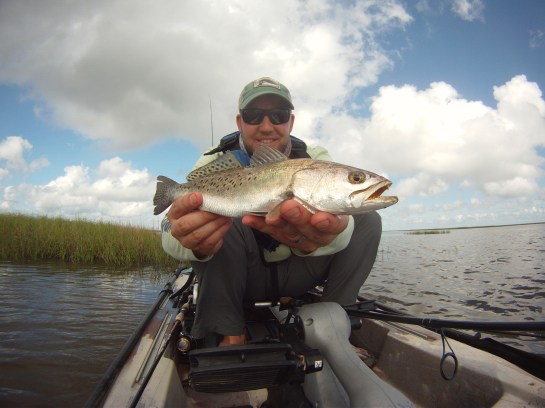
DCIM100GOPRO

DCIM100GOPRO

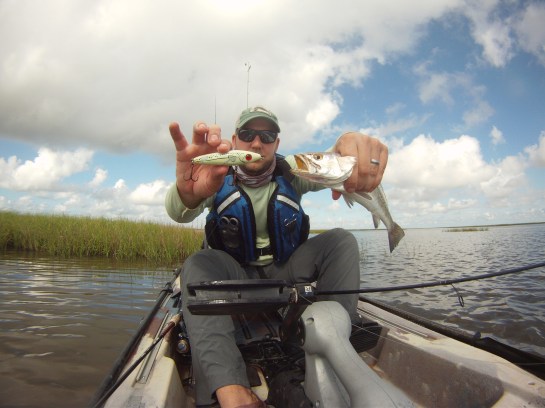
Most of the trout were in the 14-16″ range but I did get one hammer.  I was in a natural bayou fishing a point, catching dinks on the She Dog, having a good time watching the trout blow up my topwater lure.  Jameson and Brooks soon joined me as they were trying to film some of the blow ups.  I could hear some commotion behind me in front of a cut where there was obviously something attacking some balled up bait.  I drifted back and worked my lure through the area and missed a huge strike.  It was a fish that was obviously bigger than the others and we all knew it.  I threw back in and thankfully connected this time, albeit a bit closer to the boat.  It was a nice trout, 21″ on the tape, I was really thrilled to get him in the net as it has been a while since I’ve caught a solid trout from the kayak.

I had done pretty well catching trout, but everyone else was fooling around with the black drum.  The oyster flats were littered with big black drum and every once in a while you’d catch a glimpse of one as he waved that big tail at you, then disappeared under the surface.  Brooks and Jameson both got on a couple stud drum and as Jameson was fighting his I hooked up with one of my own.  The funny thing was mine came on topwater!  I’ve never seen a black drum hit a topwater before, but I guess now I can say that I have.  He didn’t smash it like a redfish will do.  It was more like a cutthroat trout sipping a dry fly.  He came up and sipped my plug then gave me a few nice runs.
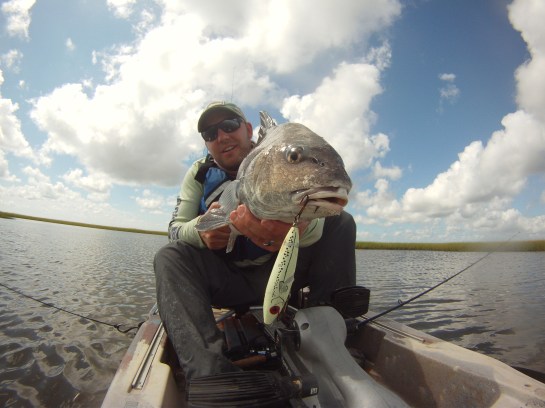
DCIM100GOPRO

DCIM100GOPRO

He wasn’t the biggest drum caught on the day, that distinction belonged to Eric, another Jackson teamer from North Carolina, but it was a fun catch.

Things kind of slowed down after that as the winds began to pick up.  It wasn’t until after we got off the water that we heard there was a Tropical Storm forming in the Gulf and making it’s way toward Louisiana.  We pressed on despite the wind and it gave me an opportunity to see just how effective pedaling into the wind was as compared to paddling.  My legs are undoubtedly stronger than my upper body thanks to a life of playing soccer and they definitely take longer to fatigue than my upper body.  That being said with paddling I have always found it to be more of a core workout than an upper body one and if done properly you rarely feel that fatigue in your arms, but tired paddling does lead to poor form which leads to more fatigue.

As things slowed down we spread out and I got lucky and made my way into a cut that was leading from the main bayou into a large lake.  It was super shallow, but protected from the wind and I began running into redfish that were cruising the shoreline, much like they were yesterday.

IMG_2238

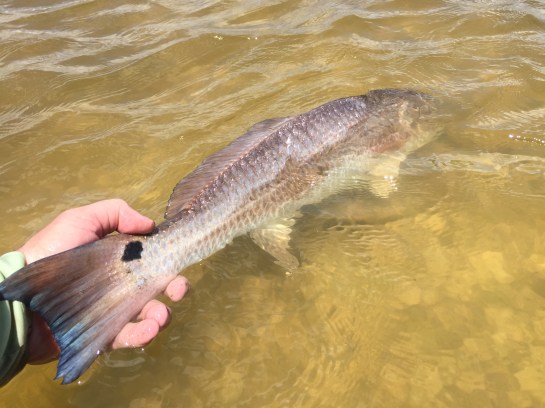
I caught one little guy on a topwater plug on my way into the lake.  I threw that plug right on a point in some grass and he came after it and blasted it as I pulled it out.  Once I got to the lake I found a shell/sand bar where I could get out and stretch my legs and wade fish a bit.  These are usually pretty good places to fish and often times trout will stack up around them.  I didn’t find any trout this time, but I did catch a nice 27″ red while out there.

DCIM100GOPRO

DCIM100GOPRO

IMG_2254

Another fish that hit the She Dog.  I saw her working the shoreline behind me in the pic and had to make a long cast over to get her.  I didn’t quite get it there, but it made enough noise to get her attention and she hit it on a beeline.

I worked the area over a bit more, but came up empty and headed back up the cut toward the others.  Of course on the way I got sidetracked by a couple more redfish that were cruising the shoreline.  They didn’t fall victim to the the She Dog, but rather the more subtle Matrix Shad.  That’s my go-to sightfishing bait, I can cast it with accuracy and I’ve got a lot of confidence in it, which is what matters more than trying pick out the perfect lure.  As I released the second redfish I could see Eddie pulling up in the skiff and figured that was a pretty good way to end the day.
One thing I forgot to touch on about the FD was the deck layout.  This boat is built for fishermen.  It is a lot like the Coosa HD, which is a boat I always liked, but never had a place for in my floatilla.  It is a great design with some pretty cool features.  Gear tracks in all the right places.  A cushioned foot pad for comfortable standing.  The new hatch system is very easy to use and a big improvement over previous hatches.  The integrated rod tube storage is a really cool feature too.  The tankwell is a bit smaller than I’m used to and I know my extra long milk crate won’t fit back there, a regular sized one will work just fine.  I used a JKrate for the first time the past two days and liked it, so I may go that direction with my tackle storage.
I was very impressed with the FD after using it the last day and a half.  The flex drive system is so easy to use too.  You can move it up or down with the flick of a toe while steering left or right can be controlled with either hand.  When launching and loading the boat the drive system doesn’t even have to come out, you just put it in the up position and treat the boat as if nothing is there which is a bonus for guys hard on gear or prone to forgetfulness – it’s a very well thought out design.  I’ve had one on pre-order for a while and am happy I made that decision.  I can’t wait for the production model to get here.